
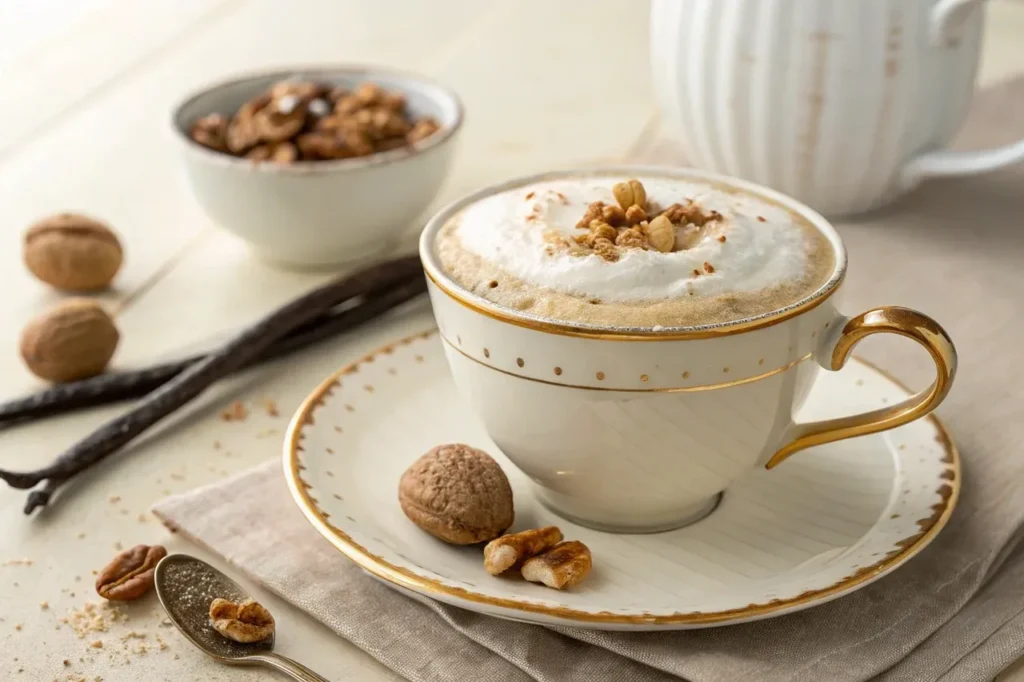
Pour a Grande Cappuccino next to a Grande Latte, and you’re looking at a 50-calorie gap — same-size cup, same espresso, same milk type, even. The difference isn’t magic. It’s foam.
A Grande Cappuccino runs 140 calories. Same-size Latte sits closer to 190. Ratio’s the whole story here- a cappuccino’s built on roughly equal parts espresso, steamed milk, and milk foam, while a latte skips most of that foam in favor of more actual milk. Less milk volume, fewer calories, simple as that. Real numbers first, then why foam makes such a difference. Or skip ahead and build your exact order in the Starbucks calorie calculator up top.
Cappuccino Calories by Size
Standard build, 2% milk:
| Size | Calories | Sugar | Caffeine |
| Short (8oz) | 70 | ~6g | 75mg |
| Tall (12oz) | 100 | ~9g | 75mg |
| Grande (16oz) | 140 | 12g | 150mg |
| Venti (20oz) | 200 | ~17g | 150mg |
Caffeine doubles right at Grande, same pattern seen across most espresso drinks — that’s where a second shot gets added. Calories keep climbing steadily with size since milk and foam both scale up together.
Cappuccino vs. Latte: Same Espresso, Different Milk Ratio
Here’s the part that confuses people. Both drinks use the exact same espresso shots at the exact same sizes — caffeine’s identical between them, 150mg for a Grande either way. What changes is everything else in the cup.
| Size | Cappuccino Calories | Latte Calories |
| Tall | ~100 | ~140 |
| Grande | 140 | ~190 |
| Venti | 200 | ~250 |
That’s roughly 50 fewer calories in a Cappuccino at every size, purely from the milk-to-foam ratio. A latte’s built mostly on steamed milk with a thin foam cap on top. A cappuccino flips that — equal parts espresso, milk, and foam, so there’s simply less liquid milk packed into the same size cup.
Why Foam Changes the Calorie Math
Foam is air and milk, mostly air. Steamed milk is just milk, no air whipped into it. Same volume of cup space, but foam takes up room without carrying nearly as many calories as the liquid milk it’s replacing.
That’s the entire mechanism behind the 50-calorie gap. Swap a third of a latte’s steamed milk for airy foam instead, and you’ve cut real calories without touching the espresso, the size, or the milk type used. It’s one of the few genuine “free” calorie savings on the whole menu — no flavor sacrifice, no customization needed, just a different drink category built around the same base ingredients.
Does Milk Choice Change Much in a Cappuccino?
Yes, same as most espresso drinks. Switch to 2% for almond, and a Grande drops to somewhere around 65-90 calories — one of the lightest full-milk options Starbucks sells. Nonfat sits in the middle ground between the two.
| Milk (Grande) | Calories |
| Almond | ~65–90 |
| Nonfat | ~110 |
| 2% (standard) | 140 |
| Whole | ~170 |
Pair almond milk with a cappuccino’s already-thin milk ratio, and the result’s one of the lightest espresso drinks on the entire menu — under 100 calories, full caffeine, real milk texture, not just black coffee dressed up.
Does Starbucks Even Serve an Iced Cappuccino?
Not really; no, not as a standard listed item. Steamed milk and foam both need heat to hold their shape, and pouring that over ice collapses the structure almost on contact, losing whatever makes a cappuccino a cappuccino in the first place. Some stores will try if you ask directly, but it won’t come close to matching the hot version. Better bet for an iced espresso-and-milk drink: Iced Latte or Flat White, both actually built for cold service from the start.
FAQs
How many calories does a Grande Starbucks Cappuccino actually have?
140 calories, standard 2% milk — about 12 grams of sugar, 150mg of caffeine.
Why is a Cappuccino lower in calories than a Latte?
Comes down to foam. Less steamed milk fits in the cup since foam’s taking up space instead, and foam just doesn’t carry the same calorie weight as liquid milk does.
Does caffeine differ between a Cappuccino and a Latte?
Not at all; same shot count at every size, so caffeine matches exactly between the two.
Can I actually get an iced Cappuccino here?
Not as a regular menu option. Foam doesn’t survive contact with ice, so most baristas will point you toward an Iced Latte or Flat White instead.
What’s the lightest way to order one?
Almond milk gets a Grande down to roughly 65-90 calories – about as light as a full-milk espresso drink gets on this menu.
Does the calorie gap between Cappuccino and Latte grow with size?
Percentage-wise, it stays fairly steady, though the raw number grows a bit at larger sizes, since there’s simply more total milk involved either way.